With college application season in full swing, the seniors at Flintridge Sacred Heart Academy are beginning the process of deciding where they will be learning for the next four years of their lives. While many seniors are looking at schools stateside, a handful are applying to colleges abroad. In addition to a love for travel, these seniors cite political instability and frustrations with the American schooling system as major motivations in their decision to go abroad.
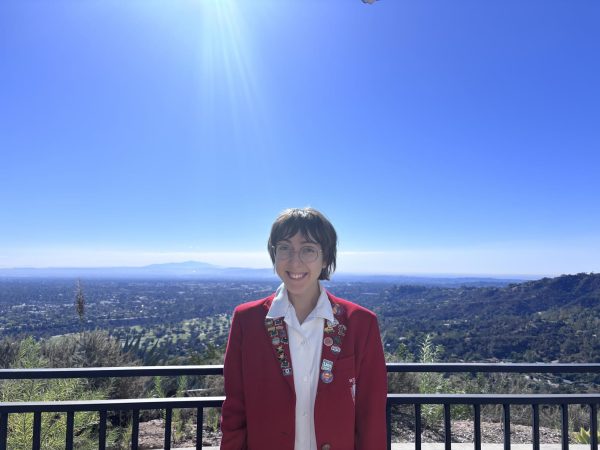
One senior applying to colleges abroad is Ali Jerman ‘27. Jerman has always been interested in attending college internationally, and decided to apply to Trinity College Dublin after a representative from Trinity visited FSHA. Jerman is also applying to the University of British Columbia, at the suggestion of a parent.
Jerman believes that enrolling in an international school is an opportunity to grow as a global citizen.
“I think going abroad [for college] is a very good experience to remind ourselves that we are not in a bubble,” says Jerman. “You get to experience other cultures and travel.”
Lyla Bostic ‘27 is also applying to Trinity College Dublin, which she visited with her family last year, and the University of Saint Andrews, in Scotland.
Bostic hopes that going abroad will enable her to customize her course schedule in a way that American universities do not typically allow.
“International schools… don’t have general education. They focus on whatever you’re studying, which I would really enjoy,” states Bostic.
Bostic also prefers the spacious dorms in universities overseas to the overcrowded living quarters common in US colleges.
“Freshman housing [at Trinity] includes a living room, a kitchenette [and] a bathroom,” Bostic says. “It’s more… humane.”
Jerman, too, is looking to avoid some of the unfavorable conditions facing college students in the US today.
“I’m also trying to escape the current political climate. [Many] places have better queer and trans rights than the US government,” comments Jerman.
But going abroad for college can have its own challenges, says Associate Director of College Counseling Ms. Paula Mora.
“Some of the travel times [can be] an issue,” says Mora. “When you’re traveling afar… there has to be an action plan in place for how you would get home [in the event of an emergency].”
Mora also cites time differences and travel expenses as potential considerations for students looking into colleges abroad.
“[It’s] definitely a family decision, too,” adds Mora. “[But students] have ample time to make that decision until May 1st.”
Although Mora says that FSHA’s college counseling department works hard to connect students with international schooling opportunities, Jerman states that the department still has blind spots when it comes to sending students abroad.
“I do not think our school does a good enough job of advocating for [international colleges],” Jerman comments. “[The college counselors] mostly give American schools. Usually [students] have to have an interest in going abroad first, and then they’ll help.”
In contrast, Bostic believes that the college counselors offer students more than enough opportunities to connect with colleges abroad.
“[FSHA does] more than other schools [to promote going abroad],” says Bostic. “I think [FSHA does] the best that an American school [can] do.”
Mora adds that FSHA’s college counseling department is looking forward to expanding students’ college lists to include international schools.
“We’re always looking at building that connection with others, especially with programs that… help increase the awareness of… [studying] away for a year and then [coming] to campus later on,” Mora says.
Jerman, meanwhile, is looking forward to the independence that comes with living in a foreign country.
“I need to… see what it’s like to live alone,” Jerman says, “And I need to get out of the house.”