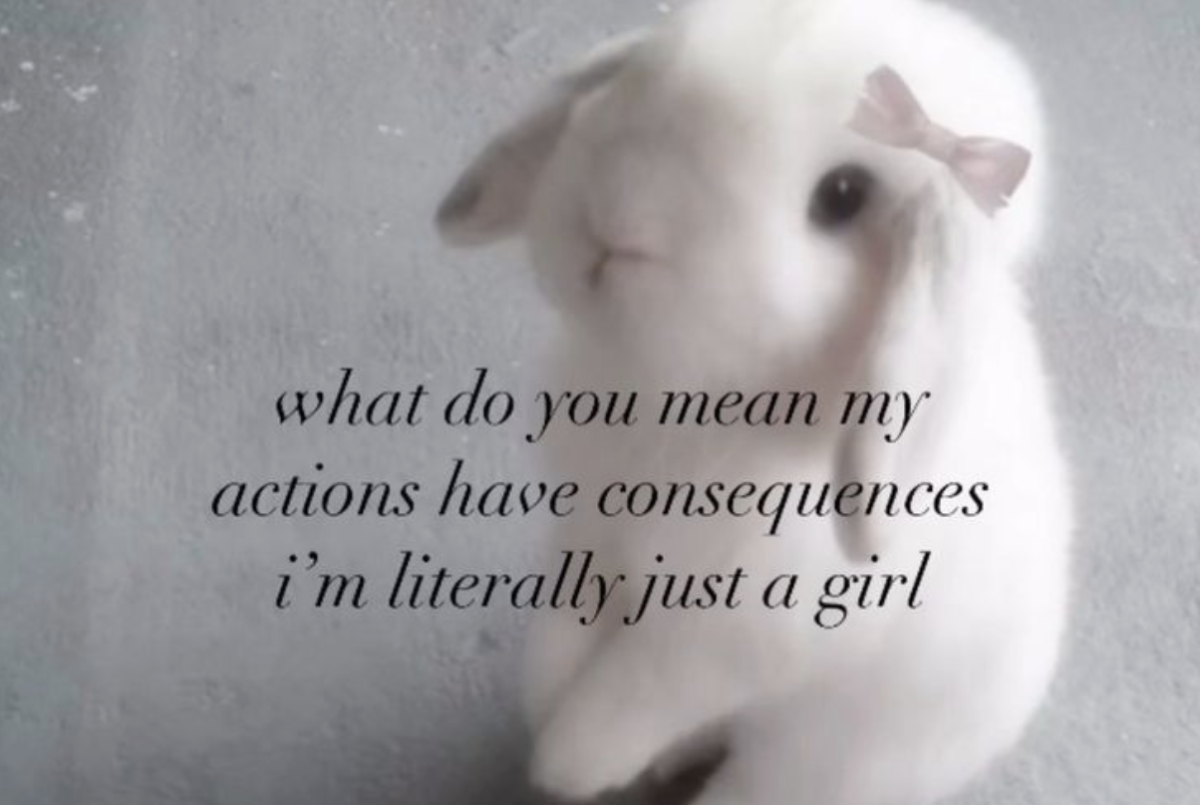
If you are on TikTok or Instagram, you may have heard the following phrases, “I’m just a girl,” “girl dinner,” or “girl math.” Even on Pinterest, images and memes littered with bows, captioned with similar phrases, swarm the feeds of many teenage girls. In these trends, women downplay their mistakes and irresponsibility by stating that they are “just a girl” or that it is simply something pertaining to being a girl. Some see it as a lighthearted joke, meant to be relatable and humorous, but some, including myself, see it as something more.
In a TikTok video by the user @/_victoria_lit, she states that, “One thing I love about being a girl is you can do and say just about anything without an excuse or reason. You can be bad at anything, and say ‘I’m just a girl.’ … No argument or real explanation needed, you could literally just say you’re a girl.”
The online trend of using the phrase, “I’m just a girl,” includes videos of women confessing they spend too much money, have trouble driving and mess up daily tasks. Of course, the “I’m just a girl” joke was funny and relatable at first. And yes, in the beginning, I did relate to accidentally spending too much money or talking too much. But then it leaned into phrases that painted women as helpless and incapable. Saying “I’m just a girl” when you make a mistake implies that a man inherently might be able to do it better. The phrase leans towards this idea that being feminine means being clumsy, ditsy and incapable.
The phrase “I’m just a girl” was popularized from No Doubt’s 1995 hit single “Just A Girl,” with the lyrics ironically touching upon how men and the media push women into roles of conformity, helplessness and fragility. Lead singer Gwen Stefani wrote the song in frustration after one night, her parents got mad at her for driving home late from a band-mate’s house. The lyrics “I’m just a girl, in the world / That’s all that you’ll let me be” explains the difficulties of how limits are always set upon women by the world, and her frustrations in that being a girl inherently makes her helpless.
Similarly, the term “girl math” is used online as an illogical reasoning to justify bad spending habits or over-consumption. It paints a picture of how women are more irresponsible with money than men are, and are incapable of not spending too much while shopping. Trends such as these allow women to take pride in being shallow, irresponsible and uneducated. When we infantilize and downplay our abilities in order to make self-deprecating jokes, it makes it much easier for anyone else to make the same jokes about us too. Then, it is much less self deprecating, and more of a mockery of women.
Another term, “girl dinner,” was started as a trend in 2023 and included women showing off snack-based meals. Again, it started as a harmless trend meant to be relatable to women who enjoy having low maintenance meals. Although, some examples of the trend became more extreme than others. According to the Cleveland Clinic, concerns with lack of nutrition, perception of portion sizes and the possibility of leading to eating disorders were raised by nutritionists with the trend of girl dinner. From another lens, girl dinner reinforces diet-culture, in that women are expected to eat less in comparison to men.
At some point, “girl humor” starts to feel more like internalized misogyny than just a joke. Sure, it can be funny sometimes and the entire point of the trend was to appeal as relatable to other women, but if you say a phrase long enough, some might start to believe it. In a trend made to connect and relate to women, it has turned into something turned against us. We should be empowering and lifting ourselves from being more than “just a girl,” especially in a time where we need it most.