
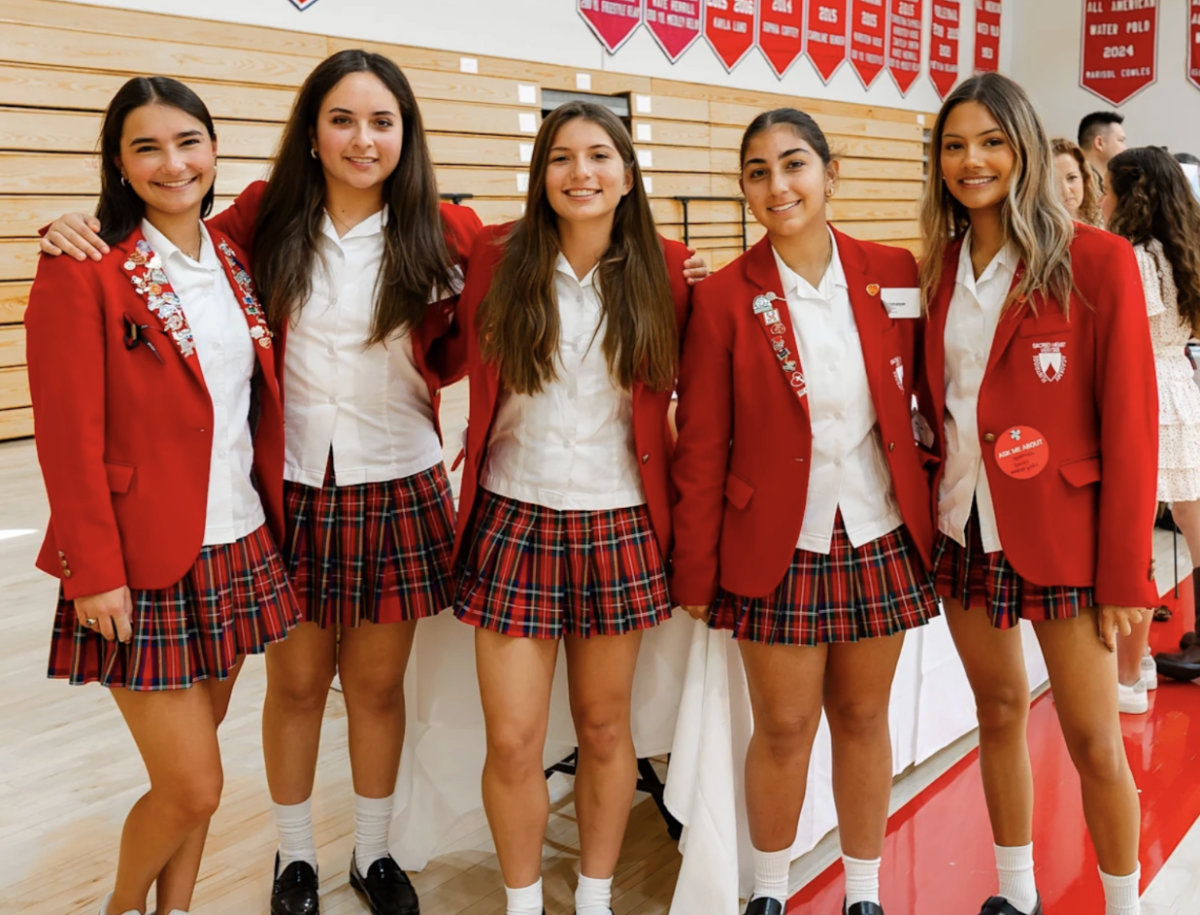
Uniform infractions. Almost every Tolog can relate to being dress coded at least once during their years at Flintridge Sacred Heart Academy, whether it was wearing a non-school hoodie, Uggs, sweatpants under a skirt or having an ‘unnatural’ hair color. But why do schools implement uniforms, and what are the benefits and disadvantages of them?
Britannica states that school uniforms were originally introduced to hide any social, class or wealth disparities between students, reducing peer pressure, bullying revolving clothing and leveling the playing field.
According to ScienceDirect, uniforms, especially in private religious schools like Flintridge Sacred Heart Academy, can foster a sense of unity, community, and order. Similarly, Britannica says, pro-school uniform groups note that having a uniform helps equalize the school’s culture and environment by “[supporting] students and [reducing] gang attire and activity, increase school safety and decrease clothing theft.” Schools that implement uniforms also report increased discipline in students, group spirit and respect for teachers, as well as higher academic standards.
“Uniforms prepare students for different expectations of the working world…[and they] remind us that we are part of a community,” says Assistant Principal of Student Life and Culture Ms. Boyoung Kim.
Wearing a standard uniform is supposed to save money for families since there is no need to buy trendy clothes to impress other people at school.
On the other hand, WebMD found that having to purchase required uniforms could instead add further financial hardship on low-income families since uniforms tend to be pricey. Uniforms specific to a school with logos made by specialty retailers range from $200-$500. Having to buy uniforms enough for one week costs about that much, not to mention purchasing school hoodies for cold seasons, the right shoes and replacement uniforms. In addition, according to the Uniform Market, data shows that uniforms for girls specifically average out to about 12% more expensive than those for boys.
Robyn Silverman, a child and teen development specialist, says that students, particularly girls, compare how they and others look in their uniforms. Comparison, body dysmorphia and even eating disorders, are common in teens, especially females, at this early developmental stage.
Teenage brains have higher hormones, making their emotions more intense, leading them to be more sensitive to peer pressure and heightening their fear of rejection. This research shows adolescent girls present higher levels of appearance-based comparison than boys, which directly ties into body appreciation and depressive symptoms. Silverman directly states that, “as a body image expert, [she] hears from students all the time that they feel it allows for a lot of comparison…So if [they] have a plus-sized body, a curvier body, a very tall body [or] a very short body, those girls often feel that they don’t look their best.” Uniforms may increase this comparison on how the skirts or polos look on others rather than them.
Many students can agree that, although uniforms do make it easier to get dressed in the morning, they can also limit how students express themselves.
While uniforms do help prepare students for working in jobs with dress codes, they do not prepare them for college where they will not have guidelines telling them what to wear everyday while rushing to get ready for their morning class.
On the issue of having colored hair that is not a natural color, psychologists from the European Journal of Medical and Health Research found that, “When individuals alter their hair color, they often report increased confidence, reduced anxiety, and a sense of empowerment.”
Hair coloring is one of the most common, and accessible, forms of self-expression, allowing the person to externalize their desire for renewal or emotional release due to the close association between self-image and mental health. In the European Journal of Medical and Health Research, researchers found, from a physiological perspective, that, “hair transformation can trigger measurable effects: increased dopamine release…and reduced cortisol levels” showing the “tactile interaction of touch, scent, and visual change [creating] a multi-sensory experience that directly impacts the nervous system.”
By allowing more leniency with uniforms regarding how one expresses themselves, students could be more creative, comfortable and thus more open to learning, and most importantly, feeling like themselves. The student would still be wearing the correct and appropriate uniform, but should be allowed to wear plain hoodies, shoes, jewelry or have any hair color due to mental health benefits proven by psychologists. Having looser policies continues to preserve the benefits of uniforms, such as unity and association of clothes with social status, while still maintaining a decrease in school-wide violations. This gives students a safe, visible way to express identity and creativity, increasing their mental health and motivation to go to and succeed in school.

dia • Oct 5, 2026 at 10:52 pm
okay ate.
Ellie • Sep 18, 2026 at 3:58 pm
Some wonderful journalistic expertise on display here, we love to see it. Never lose your sparkle Zubi
Mara Trazo • Sep 18, 2026 at 3:52 pm
This is very well written!
Rhiannon L Barry • Sep 18, 2026 at 12:20 pm
Awesome article!! I loved how you used students’ takes on how uniforms are beneficial but limit creative expression!