
For decades in cinema, global audiences have gotten used to seeing South Asia as an exotic backdrop: visually rich, culturally dense, and yet ultimately secondary to stories that rarely do justice to the region’s history and culture that these countries offer. Films such as The King and I and Indiana Jones: The Temple of Doom helped cement this pattern, showing the region through a lens of mysticism, danger, or cultural distortion, rather than a lived reality. Whether depicted as a spiritual haven, a poverty-stricken society, or a politically unstable one, the region has often been filtered through an external gaze. But beyond the reach of Hollywood, there’s a body of work that challenges this misinterpretation of South Asian regions. Emerging from smaller, underrepresented South Asian film industries, these films simply tell us their own stories, through a lens that offers realistic portrayals rather than romanticized ones.
Min Bahadur Bham’s Kalo Pothi (Nepal) offers a striking example of this shift. Set during the Nepali Civil War, the film resists the urge to center conflict as its primary spectacle. There are no sweeping battle scenes or overt political explanations. Instead, the story unfolds through the everyday lives of two young boys searching for a lost hen. The absurd simplicity of this premise is supposed to be a contrast to the gravity of the conflict that surrounds these two boys. In the movie, war isn’t dramatized. It’s ambient, and almost woven into the fabric of daily life. This narrative choice is important to note, because by refusing to frame the war through a sensational lens, Kalo Pothi captures something more elusive: the normalization of instability, and the way it subtly reshapes ordinary existence. It isn’t a story about war as an event, but about war as part of the environmental conditions. This restraint stands in contrast to Western war narratives, which rely on spectacle and the shock factor when portraying conflict in non-Western regions.
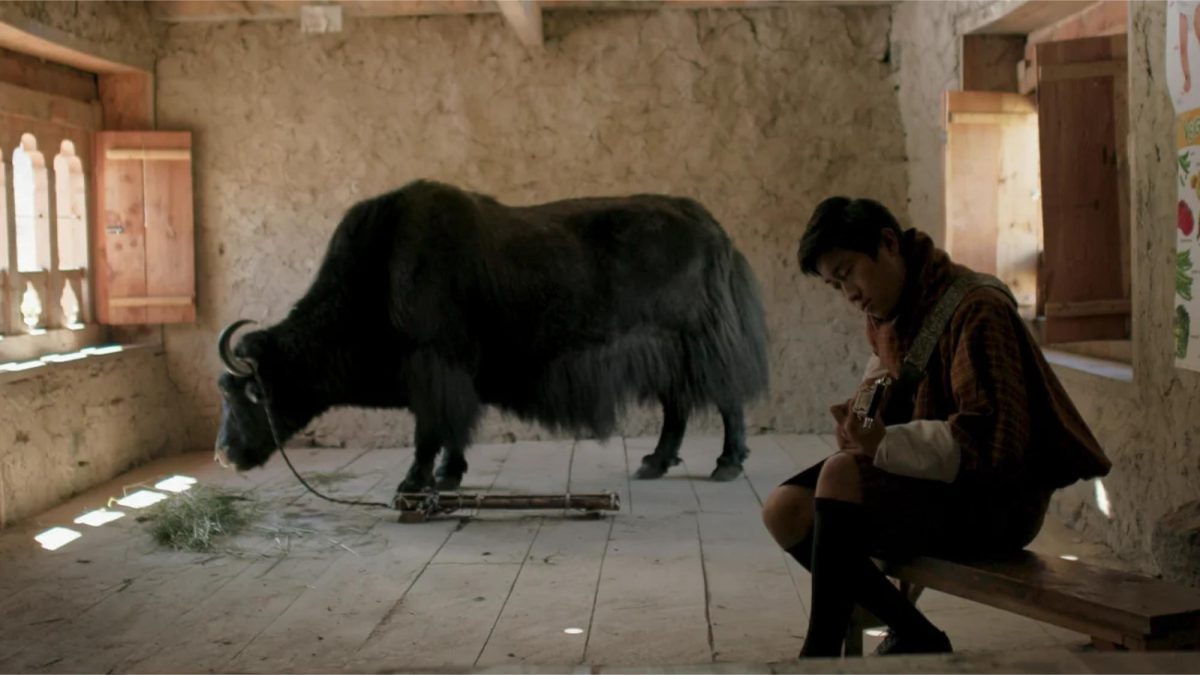
A similar commitment to lived experience is seen in Pawo Choyning Dorji’s Lunana: A Yak in the Classroom (Bhutan), though its tone is very different. Whereas Kalo Pothi is shaped by tension, Lunana is defined by stillness. The film follows a young teacher sent to one of the most remote villages in the world, a premise that could easily lean into a familiar narrative of personal transformation. However, the film does not rush to impose meaning into the movie. Instead, it allows the rhythm of rural life, such as its routines, landscapes, and moments of silence, to unfold organically. The village is not exoticized, nor is it reduced to a symbol of simplicity or hardship. It exists on its own terms. The teacher’s journey, while central, never overshadows the community itself. In this way, the film subtly reorients the viewer’s perspective, shifting the focus from individual transformation to how the community helps the individual transform. Rather than presenting the village as an exotic escape for outsiders (a common trope in Western cinema), this film allows it to exist without explanation or romantic framing.
Vimukthi Jayasundara’s The Forsaken Land (Sri Lanka) utilizes stark and minimalist cinematography, which echoes the loss and emptiness that inevitably follows war. It relies upon sparse dialogue, long static shots, and an almost oppressive amount of stillness. The characters drift through landscapes that feel both physically and emotionally barren, and their isolation feels amplified through the film’s deliberate pacing. What comes out of this movie isn’t a conventional war story, but a meditation on its aftermath. One can feel the lingering emptiness, the disconnect, and the sense of suspense that you can only feel after going through a war as destructive as shown in the movie. Forsaken Land challenges the viewer to confront the intangible consequences of violence, the pain and grief that cannot be easily voiced, or even resolved.
This is where the contrast with Hollywood becomes the most apparent. Mainstream Western films set in South Asia almost always work in the mindset of translation for their Western audiences. Cultural elements are contextualized, diluted, or altered to align with audience expectations. Narratives are often structured around an outsider’s journey, which reinforces a hierarchy in which the local becomes a less important character than the foreigner. While such films aren’t useless, they reflect a different set of priorities. Namely, a set that is shaped by the global market, and thereby a narrative familiarity dictated by Western viewpoints. Yet for all their importance in South Asian representation, these films remain largely unpopular in global cinema discussions. Limited distribution, smaller production budgets, and the dominance of mainstream industries mean that they
rarely reach wide audiences. This raises an important question. If authentic stories exist but are not widely seen, what impact can they really have?
The answer lies, partly, with the audience. Expanding one’s view of different types of entertainment is not just an act of cultural curiosity, but is critical engagement for these valuable films. Because ultimately, the issue at hand is not just representation. It is authority. Who has the right to tell a story? Who gets to define what a culture looks like on the big screens? And most importantly, whose perspective are we really willing to accept as the truth?
These films do not offer definitive answers. What they offer instead is something far more valuable, which is a choice to engage with these lesser known films, in languages one may not understand. Viewers are not just watching a new movie. They are participating in a shift towards a more balanced, and globalized world. And in this shift lies the possibility of something long overdue for the South Asian people: being seen as well as being understood.
