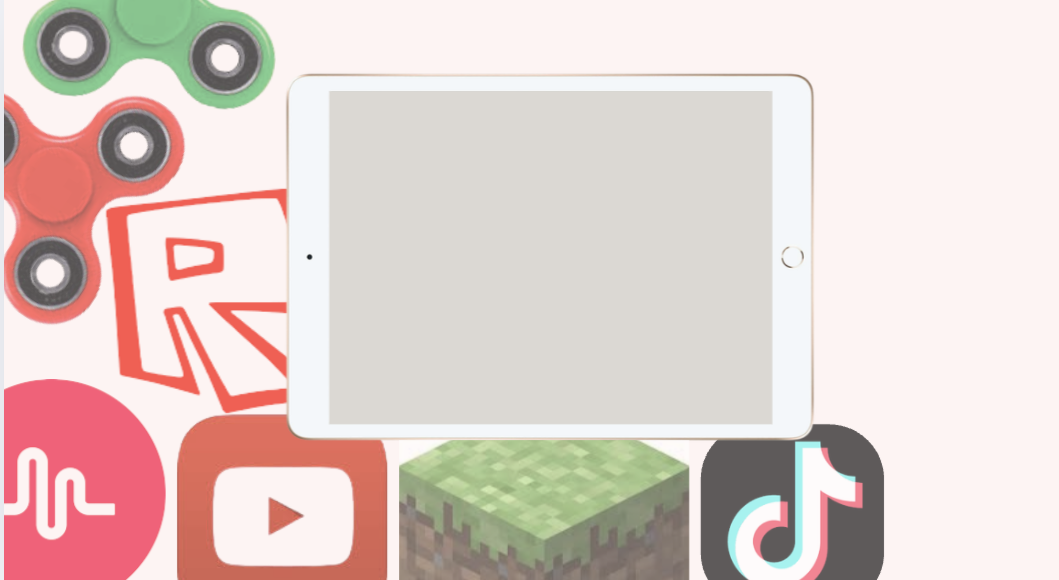
When I had spare time as a kid, I usually spent it doing three things: reading, playing pretend, or watching YouTube. While my parents made sure I maintained a balance between using devices and spending time offline, using the internet was a part of my childhood that was practically woven into my routines. Every morning on the weekends, I woke up, checked the time, and watched YouTube for an hour. In the evening, after my parents picked me up from after-school care, I played Roblox on our desktop computer until it was time for dinner; afterwards, I would read until it was time for bed.
For many Gen Z born late in the generation, including myself, the internet played a major role in our childhoods. Gen Z (born 1997-2012) is the first generation that has been fully formed by an internet world.
“I was probably four [when I started using the internet],” recalls Veronica Millett ‘27. “I remember [watching] music videos on YouTube, and from there I started watching more kinds of videos.”
“I believe I was about seven or eight years old,” recounts Jane Hernandez ‘26, “but my experience with the internet, it was very much moderated when I was younger. My parents would only really let me use the internet for YouTube channels like PBS Kids or Disney.”
“I was about six to eight years old and bored while my mom would be talking with her friends,” Alexia Colletta ‘27 remembers. “So, she would give me her phone and I would go on YouTube and watch videos.”
YouTube was generally the starting point for many kids on the Internet. Video game play-throughs, family vlogs, and toy unboxings attracted millions of views, usually from children. These kid-oriented videos made a space on the internet for children to get used to the digital world through their fast-paced editing, bright colors, and child-targeted messaging. YouTubers influenced us to purchase the games they played and the toys they unboxed.
“I watched Minecraft, Pokémon, and Animal Crossing gameplays at that time as well… seeing other people play those games informed me, ‘oh, this game seems fun,’ so I’d get [those games],” Hernandez explains.
Similarly, I remember urging my mom to buy ‘blind-box’ toys after watching YouTubers. These YouTubers were usually kids my age and would model play. Playtime, therefore, came to a business that relied upon creating demand in children. On the rare occasion she would buy me these toys, I would go into my room and unbox them carefully and slowly, pretending to be a YouTuber opening them for a camera.
Not every member of late Gen Z used the internet as a child, of course. However, even for those offline, the internet still made its way into daily life. Trends originating online populated kids’ feeds, and the kids then brought those trends to schools.
For Olivia Lee ‘27, who was not a regular internet user as a child, internet trends were still inescapable: “I knew about slime and fidget spinners just from people talking about it at school. Even when I wasn’t exposed to slime videos on the internet, people would talk about their favorite slime YouTubers. I remember really wanting to make slime. Fidget spinners, too– I really wanted them.”
Looking back now, as an older high schooler, I realize the unique alignment of our childhoods with the rise of the internet, specifically on mobile devices. This, then, reveals an interesting question: how were we affected by the internet’s prevalence in our childhoods? And, are we better or worse off for it?
An immediate result was the shortening of our attention spans. As we got older, we started branching off from YouTube into other social media sites, like Instagram and TikTok. TikTok was one of the first sites to have short-form content and an algorithm that hooked viewers into watching for hours, instantly gratifying users’ need for quick dopamine hits. However, as we started using other sites, like Instagram, and continued to use YouTube, they started to implement short-form content to compete with TikTok’s short-form content model. Suddenly, short-form content was almost unavoidable, and it started to have noticeable effects on us.
Millett has seen a decline in her attention span. “It’s a lot harder now to focus on things for a long period of time compared to when I was little. And, maybe that might be partially because I’m busy, but it’s also a hundred percent because I’m just sitting,
scrolling, for hours a day.”
Even though many members of late Gen Z didn’t use sites like Instagram and TikTok until they were teenagers, the internet’s prevalence in their childhoods made it much easier to make the natural jump from long-form to short-form content.
Internet use as children has also affected how we decide to spend our free time. Prior generations of kids had many options for busting boredom: special hobbies, books, physical toys, and TV, for example. For many Gen Z, the internet was a major rival for all of these options combined. Why spend time on these activities when you could lose yourself in the highly stimulating, easily accessible content directed at kids your age online? Since we turned to the internet to alleviate our boredom then, we continue to turn to the internet to fill our time now. With content becoming even more addictive on sites designed to keep users watching and
scrolling, it’s become difficult for many to even turn to other, non-internet-related activities, which we might’ve spent some time doing in the past.
For Colletta, she considers her childhood to be more balanced in terms of screen time compared to now. “As a kid, half of my time was on the internet, but usually I would go outside more, and I would play with my friends. Now, I feel like it fluctuates from time to time. Freshman year [and sophomore year], I was constantly on my phone. [This year], I’ve been going out every single weekend with my friends instead of being on my phone all the time, which is good. But, I’m still on my phone. If I don’t have homework, I’m usually going to be on my TV or my phone.”
Growing up with the Internet clearly had its negative effects. However, it undeniably shaped a generation, from our humor to our habits. And, for better or worse, it introduced us to a world beyond what we knew.
“The internet is so vast, and it has so many bad things on it, but, in the long run, I think it helped me have more of an understanding of the world,” Millett remarks. “Even if I was on it a little too much, and I still kinda am.”