
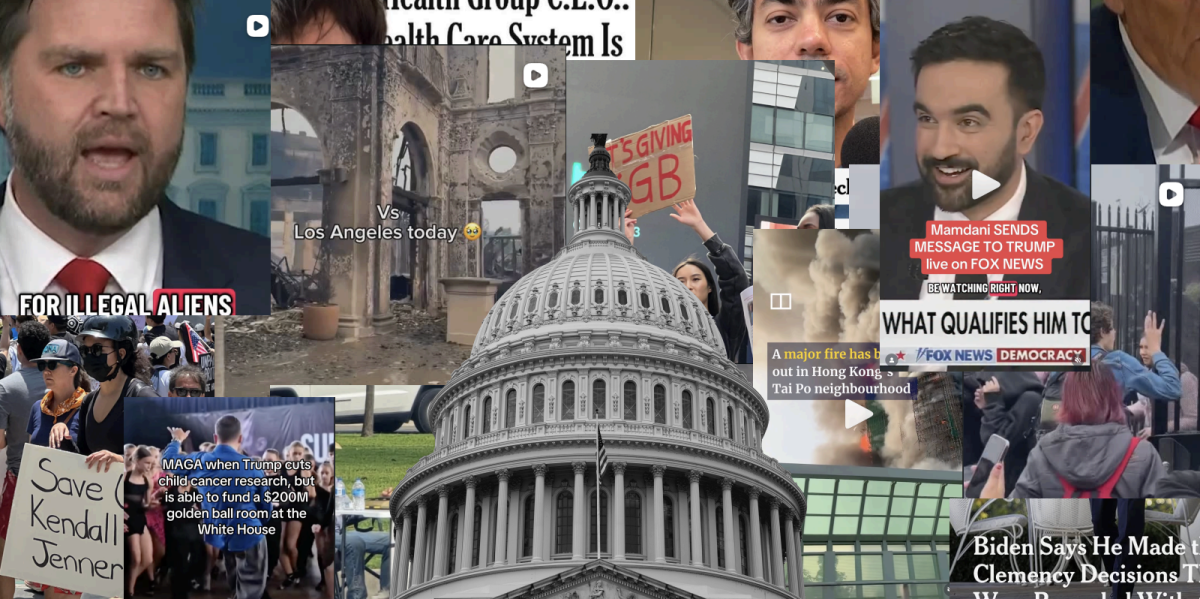
Between swipes on TikTok, the future is being written. Every scroll is news shaping how people see, and might change, the world. Now, the world fits right into the public’s hands. In headlines, comments, outrage cycles, or tiny sparks of hope. News no longer arrives as a folded newspaper on the porch; it buzzes in pockets.
A survey of 34 Flintridge Sacred Heart Academy students reflects this shift clearly 79.4% get their news from social media, and 67.7% rely on online news outlets. This is a generation constructing its understanding of the world from fragments and constant feeds. The political landscape is changing, and many FSHA students feel this shift as well.
For decades, political power belonged to those who controlled the microphone, but now, the microphone is in everyone’s hands. Anyone with a phone can spark a movement, expose a problem, organize a crowd or reframe a conversation. Digital culture didn’t just modernize politics, it rewired it entirely. Politics is no longer a distant arena with gatekeepers, instead a network to step into anytime.
FSHA students are a part of this shift, and despite being constantly surrounded by news on social media, the poll shows that 56% say political news feels uninteresting, yet more than half still engage with it regularly. That alone shows that even when politics feels far away or overwhelming, students are still paying attention, still thinking, and still forming opinions. That’s not apathy but rather advocacy waiting to be used.
However, Valentina Jaimez ‘27 remarks, “Depending on the news, on Instagram and TikTok, you can’t really digest information, and misinformation is really prevalent.”
Along with this, the fast paced news cycles on social media has affected Jaimez.
“This makes me feel really frustrated, and it feels like news is just becoming another trend. When it’s something you really care about, and you feel happy that [the internet is] talking about it, all of a sudden people move on to something new.”
Jaimez’s comment reflects the mixed feelings students have when interacting with news on the media.
Media consumption is a multifaceted experience, with positives and negatives. However, digital habits aren’t distractions, they are a new form of participation. Scrolling isn’t silence. Sharing a reel, sending a post, pausing to fact-check, or listening to a creator break down a policy are all acts of engagement. Rather than understanding the world from one place; it is built piece by piece, like a collage. This is a generation refusing to treat politics as something happening somewhere else. It is happening on screens, in group chats and in classrooms with real-time reactions to real-time events. If news is moving too fast, it’s up to the consumers of the media to slow down the pace when needed.
The rise of politics in social media shows that political voices do not need to sound a certain way or be perfectly polished. The time to shape the world is now. FSHA students have access to the tools, the networks and reach to not only fulfill the potential of their distinct voices, but to change the world for the better with it.
Conversations, whether that is on Instagram feeds or with others, shape communities and actions, big or small. This can shape what comes next.
The next era of politics will be shaped by people willing to question, speak, listen and create. that is something seen at Flintridge Sacred Heart daily in class debates, essays that push boundaries, and in moments when students challenge assumptions and demand better.
Every student carries the raw materials of leadership, curiosity, discernment, empathy and courage. Every scroll, every conversation and every question is practice. Every disagreement, every shared idea, every spark of passion is fuel.
The next era of politics isn’t waiting in city halls or council chambers. It starts in classrooms, hallways, group chats and living rooms. It starts with FSHA students realizing that their voices can shake the world. Tologs, the world is listening, and it’s waiting. Will you make them hear you?
