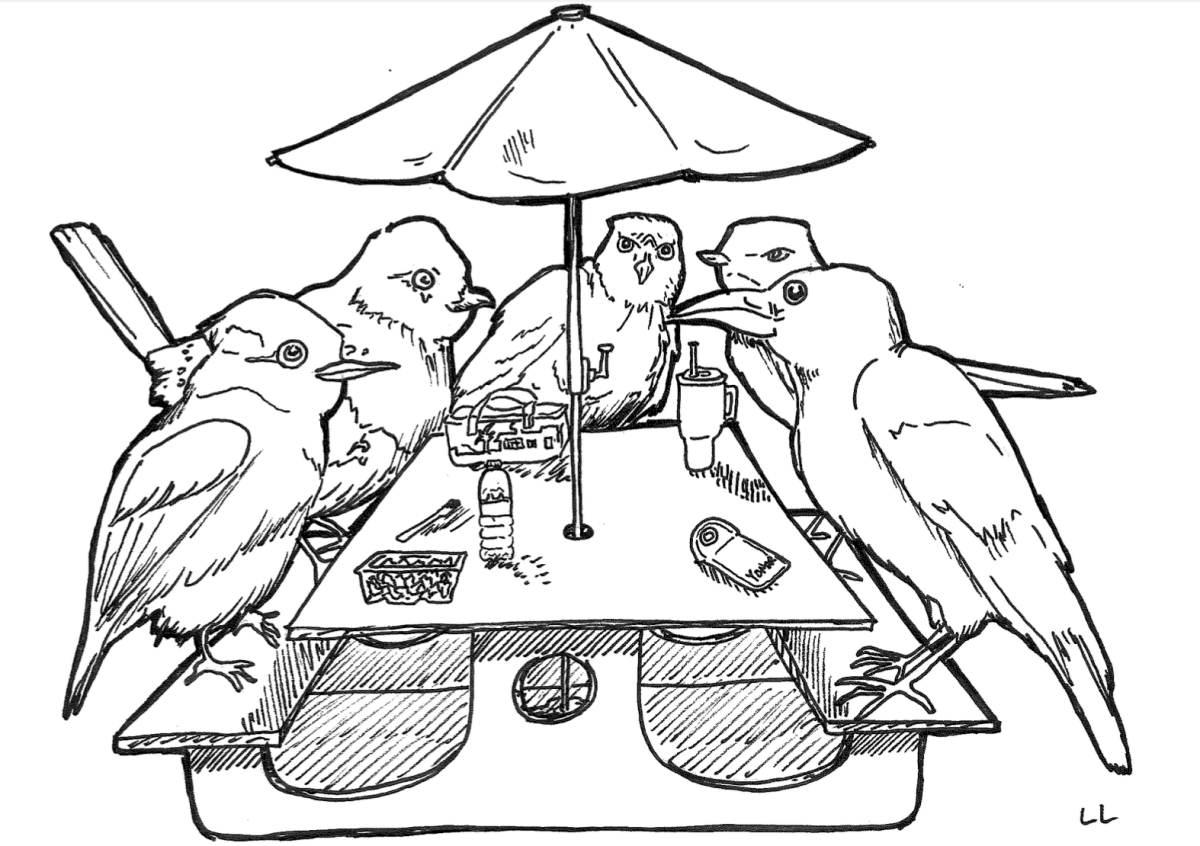
The population of Flintridge Sacred Heart Academy numbers roughly five-hundred and thirty: four hundred and four students, one hundred faculty and staff, and twenty-two different varieties of bird. Deceptively intelligent and complicated creatures, FSHA’s birds are as interesting and diverse as its people.
“Springtime is the best time [for bird watching],” says Mrs. Candace Toogood, Science Teacher, “That’s when you’re hearing the most calls because that’s when mating season occurs.”
The Spotted Towhee (Pipilo maculatus) is one of many breeding birds found on campus. Perhaps the definition of “coming on too strong,” male towhees spend ninety percent of their mornings singing to attract a mate. The local Black Phoebe (Sayornis nigricans), too, exerts himself to win a mate, wooing females with tours of prospective nest sites.
Not every bird of the Hill is as friendly. Despite symbolizing innocence in Harper Lee’s To Kill A Mockingbird, the Northern Mockingbird (Mimus polyglottos) can be a real piece of work. In an article entitled: “Why Do the Mockingbirds Rage?” Arlington Regional Master Naturalists describes mockingbirds as “vicious” birds who stage “prolonged [attacks] on hapless” animals.
The invasive European Starling (Sturnus vulgaris) is similarly problematic.
“Starlings have really beautiful feathers which kind of shimmer in the sun,” says Mrs. Toogood, “But they’re also really evil… They’ll go ahead and get the acorns that the Acorn Woodpeckers put [in a cavity] and drop them on the SAC… They’ll even kick out the eggs or the little fledglings!”
Such trickery is indicative of birds’ intelligence. The native American Crow (C. brachyrhynchos), for example, possesses a complex social order and can count to three or four. Crows- they’re just like us!
“Crows, they aren’t anything special to the Hill, but they are a brilliant constant,” says student and bird enthusiast Courtney Kruse ‘26, “They have a great range of calls, and have been shown to be able to roughly replicate some human speech and noises.”
Ms. Katherine Guerrero, Director of Mission and Belonging, reaffirms the connection between birds and humans, citing her cultural relationship with the Red-Tailed Hawk (Buteo jamaicensis).
“In… Native communities hawks are seen as… carriers of ancestors,” says Ms. Guerrero, “So when you see a hawk you take it as a blessing, like, it’s presenting itself to you to let you know that your ancestors are here [protecting you].”
Other raptors are more difficult to identify with. With beady eyes and skin like beef jerky, the Turkey Vulture (Cathartes aura) is the least cuddly of the local raptors. What it lacks in warmth, however, it makes up for in vomiting. When threatened, Turkey Vultures may vomit up to ten feet to deter predators (a self-defense strategy that will not be taught in Human Development this year).
With practice, however, students can develop an appreciation for even the most bohemian of birds. Unlike most other scientific pursuits, bird watching requires little equipment and no prior experience. In return, it offers Tologs valuable insights into the local ecosystem and the unique creatures that inhabit the Hill.